Best Bath Store
All Natural Blend of 14 Herbs Gentle Cleanse- $20 Off Colonix Now! Use Promo Code 20J
Amberen - Breakthrough Menopause Treatment
728x90
Custom Search

Friday, July 16, 2010

Assessing the lower-limb arteries

Blood is normally supplied to the leg through a single main artery (Figure 7). This has different names in different parts of the leg: common and external iliac arteries in the lower abdomen, common and superficial femoral arteries in the thigh, and popliteal artery behind the knee. Below the knee it branches into the smaller posterior tibial, peroneal and anterior tibial arteries. The reason for scanning these arteries is to locate and assess any narrowing (stenosis) or blockage (occlusion). A general review of the role of ultrasonic scanning in the diagnosis of peripheral arterial disease is given by Polak [4] .

Figure 7: The main arteries of the lower limb.

Patients are normally referred with claudication (pain on walking, particularly uphill) or with ulcers around the ankle and on clinical examination the ankle pulses are likely to be weak or absent. The main options for treatment are either (a) to encourage the patient to exercise and develop collateral vessels to take blood around the site of disease, (b) to perform angioplasty which involves passing a balloon catheter down the artery and inflating it at the sites of narrowing or blockage to dilate the vessel, or (c) to surgically insert an graft to bypass the diseased portion of the vessel [5] . The clinical information required is therefore the site and severity of any narrowing of the vessel and the site and length of any blockages of the main vessels. In the presence of multiple stenoses, the study can indicate which are causing the more critical restrictions to blood flow. The referring clinician can use this information to decide whether intervention is appropriate, and, if so, whether to proceed to angioplasty or to insert a graft [6] .

The examination starts with the patient lying supine with the head slightly raised. Coupling gel is put on the thigh from groin to knee over the path of the artery. The probe is placed on the skin in the groin and the common femoral artery identified using the colour Doppler display. The scanner is switched to duplex mode, and the blood velocity waveform in the common femoral artery is obtained. The waveform is usually biphasic or triphasic. The peak systolic blood velocity normally lies between 90 and 140 cm/s (ref 3, p 260). Values significantly above this may indicate local stenosis, while values below can indicate low flow caused by proximal or distal occlusion. The presence of any plaque intruding into the lumen is noted, and the degree of stenosis is estimated. (Figure 8) shows a scan of a femoral artery with a small protruding plaque causing about 20% stenosis.


Figure 8: A plaque protruding into the lumen of the common femoral artery. The plaque (PL) is small and is causing about 20% stenosis.

The shape of the waveform is important because a monophasic waveform can indicate proximal disease in the iliac vessels. The biphasic or triphasic waveform occurs because the main blood vessels in the leg are elastic and are dilated by the increased pressure during systole. This creates a reservoir of blood which empties during diastole. The volume of blood in the reservoir is more than enough to supply the limb, and the excess flows back up the vessel into the abdominal aorta creating the reverse flow component (Figure 9). An abnormal monophasic waveform without the reverse component occurs when the volume in the reservoir is insufficient and extra flow is required during diastole. This is usually because an iliac stenosis or occlusion reduces the blood available to fill the reservoir during systole, but may also occur when there is a large flow to the limb caused by exercise or gross infection.

Proximal disease can also be indicated by turbulence in the common femoral artery. Turbulence is created in eddies distal to a tight stenosis, and the eddies then travel downstream with the blood flow. They can be detected as spikes in the blood velocity waveform (Figure 10), usually on the downslope at the end of systole. The turbulence is more likely to be created during peak systole when the local blood velocity is highest, but appears later than this distally because the systolic pressure pulse travels faster than the eddying blood. The delay between peak systole and the appearance of the turbulence in the common femoral artery can give an indication of the site of the proximal iliac stenosis. Jager et al [7] have described the shape of the waveform in the lower-limb arteries and the changes associated with different degrees of stenosis.


Figure 9: Schematic generation of a biphasic waveform. During systole (a), the heart pumps blood into the peripheral vessel and the branches. The peripheral vessel expands. During diastole (b), the vessel contracts. There is more than enough blood in the vessel to supply the periphery, and the excess flows backwards into the more proximal branches. A biphasic waveform is obtained at the point marked with an asterisk.


Figure 10: Turbulence in the common femoral artery. The blood velocity waveform contains spikes (marked I) just after peak systole. These represent turbulence generated from a proximal tight stenosis
The probe is then moved along the artery until the origin of the profunda femoris artery is identified using the colour Doppler display. This is usually just beyond the skin crease in the groin. The blood velocity waveform at the origin is obtained, the waveform shape noted and the presence of any stenosis recorded. The position of the origin can be marked on the skin surface using a water-soluble crayon.
The superficial femoral artery is examined along its length using the colour Doppler display. The colour scale is set so that the normal blood velocity in the vessel is just below the top of the scale. Any increase in velocity caused by a stenosis will therefore go above the scale, causing aliasing and its characteristic display. Whenever a stenosis is suspected, the blood velocity waveform is obtained just proximally and the peak systolic velocity measured. The duplex gate is then moved through the stenosis, monitoring the waveform until the maximum velocity is obtained. A significant stenosis is normally taken to be one that more than doubles the blood velocity [4]. The site of any significant stenosis is marked on the skin surface and the distance from the vessel origin and the increase in velocity recorded. Figure 11 shows a superficial femoral artery stenosis. The plaque causing the stenosis can be seen and the colour Doppler shows aliasing. The peak systolic blood velocity, (Figure 12), increases from 0.26 proximally to 3.90 m/s through the stenosis, an increase by a factor of 15 indicating a very tight stenosis.
Occlusion is characterized by a gradual fall in blood velocity along the vessel as blood is taken away by collateral vessels. The waveform usually becomes monophasic close to the occlusion, and at the blockage the colour Doppler display shows absence of flow. When flow is low, it can be difficult to determine the precise point at which flow ceases, and the operator must ensure that any flow shown is within the vessel rather than along a nearby collateral. When an occlusion is detected, the operator marks the start on the skin, and then continues to track down the artery using the colour Doppler display until flow is again identified in the lumen. The distal end of the occlusion is marked and the length measured.
As the scan progresses down the leg, the artery becomes deeper and can be difficult to image, particularly in larger patients. The vessel is scanned as far down the leg as possible and the blood velocity waveform recorded from this distal site. The position is marked on the skin. To complete the examination of the lower-limb arteries, the patient turns onto their side or front and the popliteal artery is scanned behind the knee. Waveform shape, peak systolic velocity and the presence of plaque are all recorded.
Where the distal superficial femoral artery is deep, there may be a portion of the vessel that is not accessible from the front or the back. This can limit the accuracy of the scan, especially in the adductor canal just above the knee. Problems can also be caused by a vessel with multiple calcified plaques, which block the ultrasound preventing a clear view of the vessel. However, an experienced operator can use other clues such as the presence of turbulence and changes in waveform shape to determine the presence of significant disease. Where there is an occlusion or tight stenosis, collateral vessels re-entering distally can supply blood at high velocity which can mimic a stenosis. The collateral vessel can sometimes be identified by the presence of colour outside the main lumen.


Figure 11: A superficial femoral artery stenosis. The colour image shows aliasing, a sharp transition from maximum speed away from the probe (light blue) to maximum towards (yellow). The lumen is narrower at the stenosis and the brighter echoes in the near wall show the presence of plaque, which is causing shadowing to the right of the image.


Figure 12: Velocity waveform through a stenosis. The peak blood velocity through this superficial femoral artery stenosis is greater than 3.9 m/s, compared with 0.26 m/s just proximal to the stenosis. This increase in velocity shows a very tight stenosis.

A full lower-limb scan may be time-consuming since the whole length of the artery must be scanned carefully. About 30 minutes is needed for a full unilateral study and 50 for a bilateral study. Other tests are sometimes performed at the same time, and it is common to include a measurement of the ankle/brachial pressure index (ABPI) which extends the study by about 10 minutes [8] [9] [10] .
The ABPI (ratio of ankle arterial systolic blood pressure to brachial pressure) is normally greater than 1.0, and ratios lower than 0.90 at rest are usually considered abnormal and indicative of lower-limb arterial disease [8]. However, an artifactually low reading may be obtained if the ankle signals are weak and of low amplitude. Headphones can be useful to ensure that the signal is heard as soon as it returns as the cuff pressure is reduced. Artifactually high readings may also be obtained if the leg arteries are calcified and cannot be compressed. This happens particularly in diabetic patients. In these cases, the arterial waveform at the ankle can help to exclude disease since a biphasic waveform, with both forward and reverse components, indicates absence of severe flow-limiting disease. For all these pressure measurements, it is important that the cuff is the correct size [11] . Ideally, the ratio of cuff width to limb circumference should be around 0.4, and it is good practice to have a large cuff available for large or swollen limbs. Reducing errors is especially important if ABPI is the only measurement being made and the patient is not proceeding to duplex scan.
Proximal and distal arterial scanning

If iliac disease is suspected, either from clinical examination or from a monophasic common femoral waveform, the aorto-iliac segment can be scanned [12] . A 3.5 MHz probe is usually used to give better penetration and a wider field of view. Access to the vessels can be difficult if overlying bowel and bowel gas block the ultrasound. Some centres give an enema before scanning this region, but in thin patients a satisfactory examination is often possible without bowel preparation. The operator is again looking for narrowing or blockage of the artery and the same criteria are used. If distal disease is suspected, some of the small arteries below the knee can be examined. The posterior tibial artery is usually accessible just above the ankle from the medial aspect, and can be traced up the leg as it gets deeper. The artery runs parallel to a pair of veins (Figure 13) and this can aid identification. The operator is again looking for evidence of stenosis or occlusion, but these vessels are small and close to the limit of resolution of all but the most modern scanners, and absence of detected flow may indicate lack of sensitivity of the equipment rather than occlusion.

Figure 13: Peroneal artery and paired veins. The arterial flow, shown in red, is from left to right with a component towards the probe. The venous flow, shown in blue, is in the opposite direction. The anterior and posterior tibial arteries also lie between paired veins.


http://www.blogger.com/www.worldwidewounds.com/.../Doppler-Imaging.html

Assessing the lower-limb veins for incompetence

The lower-limb venous anatomy is complex and variable, but the veins can be divided into deep veins, superficial veins and perforators. The purpose of the veins is to return blood back to the heart, and when standing this has to be done against gravity. To assist the venous return, there is a pump operated by the calf muscles. As these contract, they squeeze blood out of the calf and up the leg. One-way valves in the veins prevent the blood from falling back as the muscles relax. The muscle pump is more effective in the deep veins, so the venous anatomy directs the blood from the superficial veins to the deep veins. (Figure 14) shows the main veins in the calf and thigh: the common femoral, superficial femoral, popliteal, posterior and anterior tibial and peroneal veins are all part of the deep system. The main superficial veins are the long and short saphenous veins, and there are also the gastrocnemius and posterior thigh veins. The long and short saphenous veins join the deep veins at the sapheno-femoral and sapheno-popliteal junctions respectively. Perforators link the superficial and deep systems, and contain valves to allow flow only from superficial to deep. Normal venous anatomy is variable and becomes more so in disease when superficial veins enlarge and become varicose. Some of the variations seen on duplex scanning have been described by Somjen


Figure 14: The main veins of the lower limb. The long and short saphenous veins are superficial veins and the remainder are deep veins.


The main reason for scanning these veins is to detect veins in which the valves leak. The leakage may be due to valvular damage or to venous distension [14] . If the valves leak, the veins become incompetent and the blood falls back under gravity as the calf muscles relax, increasing the venous pressure because of the hydrostatic pressure of the column of blood being supported. The condition is known as venous insufficiency. Persistent increased pressure causes superficial veins to dilate producing varicosities, and causing tissue damage distally, showing first as changes in skin colour and progressing to ulceration. The main purpose of treatment is to reduce the excess venous pressure, and this can be done surgically or using bandages. Surgical treatment removes or ties the incompetent veins, and is suitable for superficial vein incompetence since there are other veins which can carry the venous return. The veins are tied at all points where the higher pressure blood from the deep veins enters the superficial system. This is usually at the sapheno-femoral junction or the sapheno-popliteal junction or through incompetent perforators linking the deep and superficial systems. However, the deep veins cannot be removed or tied since they are required to return the blood to the heart. If the deep veins are incompetent, the leg is bandaged to increase the external pressure so that the tissue pressure more closely matches the venous pressure [15] . The applied pressure is graded, being greater at the ankles and decreasing up the leg to encourage the venous return [16] [17] .

The clinical requirement is therefore to identify any superficial incompetent veins and to locate the points where blood is entering from the deep venous system. The presence or absence of deep vein incompetence must also be determined. If there are several incompetent vessels, it can also be useful to indicate which appear to be more significant. A simple examination can be performed using a hand-held continuous wave Doppler unit [18] but this only gives limited information and a full colour duplex scan is preferable. The duplex technique is described in detail by Polak [3]. Patterns of venous reflux have been described by Myers et al [19] and Lees and Lambert [20] , and correlated with clinical symptoms and signs by Labropoulos et al [21] . Further validation of the duplex colour flow examination has been described by Pierik et al [22] .

The examination starts with the patient standing facing the investigator, or lying supine on a couch tilted feet down at least 20� from the horizontal. This is to ensure the veins are filled, and also to ensure that gravity will return blood through any incompetent veins. Coupling gel is put on the probe, which is placed lightly on the skin in the groin over the femoral vein. A light probe pressure is essential, since too great a pressure can narrow or occlude the vein. The femoral vein is identified using the colour Doppler display, and the probe moved along the vein until the site of the sapheno-femoral junction is located (Figure 15). This is near to the point where the femoral vein comes closest to the skin surface. The colour box is placed on the image of the femoral vein just distal to the junction and the thigh is squeezed gently. Flow should be seen in the vein, the colour indicating flow towards the abdomen.The squeeze is then released, and the image inspected for any reverse flow during the release. Any reverse flow persisting for more than one second is normally taken to indicate significant incompetence (ref 3, p 234), although some workers use 0.5 sec [19] or 0.6 sec [20] as the cut-off. The colour box is then placed over the image of the sapheno-femoral junction where the long saphenous vein meets the femoral vein, and the thigh again squeezed and released (Figure 16). Reverse flow persisting for more than 1 sec indicates significant long saphenous vein incompetence.


Figure 15: Longitudinal scan of a sapheno-femoral junction. The superficial long saphenous vein (LSV) joins the deep superficial femoral vein (SFV) to form the deep common femoral vein (CFV)

Figure 16: A normal sapheno-femoral junction on squeeze/release. The blue in the long saphenous vein shows flow towards the heart. The blood velocity waveform shows flow towards the heart as the thigh is squeezed and the flow continues in the same direction as the squeeze is released.

Although this procedure can seem straightforward, there are conditions which make the study difficult. The thigh can be difficult to squeeze, and in this case a co-operative patient can perform a Valsalva manoeuvre. The patient breathes in, closes their mouth and nose or throat, and increases the abdominal pressure by trying to force air out against the obstruction. The increased pressure is transmitted to the veins, and reverse flow is seen in the femoral or long saphenous veins if these are incompetent.

Some patients may have recurrent incompetence which has developed since previous surgery. In these cases the long saphenous vein (LSV) may have been ligated and may not communicate directly with the femoral vein. However, small collateral veins may have opened, linking the femoral vein to the more distal LSV, or there may be incompetent perforators linking in the same way (Figure 17). The next part of the study is therefore to identify the long saphenous vein at mid-thigh level and to assess the degree of any incompetence in the same way as before. The probe is placed over the long saphenous vein on the antero-medial aspect of the thigh, posterior to the path of the superficial femoral artery. The calf is squeezed and released, and the presence and approximate duration of any reverse flow is noted (Figure 18). If an incompetent LSV is demonstrated, the vein should be traced proximally up the thigh to identify the source of the incompetence and in particular to look for the sites of incompetent perforators, which can be marked on the skin surface with a crayon.


Figure 17: A large incompetent upper thigh perforator. The large perforator joins the deep superficial femoral vein (SFV) to the superficial long saphenous vein (LSV). On release of a thigh or calf squeeze, blood would flow from the deep vein through the incompetent perforator into the superficial system.


Figure 18: An incompetent long saphenous vein. There is normal forward flow on squeezing the lower thigh (SQ), but the flow reverses when the squeeze is released (REL). The reverse flow persists for more than two seconds, indicating significant incompetence.

The patient then turns round to face away from the investigator, and relaxes the leg being examined. The probe is placed behind the knee, the popliteal vein and the sapheno-popliteal junction identified and assessed for incompetence by squeezing and releasing the calf. If superficial incompetence is demonstrated, it is important to identify which vein is incompetent. This is usually the short saphenous vein (SSV), but may also be the posterior thigh vein or the gastrocnemius vein.

Having assessed the main deep and superficial veins, it is important to examine any varicose veins to assess how they are being filled. They are usually filled by reverse flow in an incompetent superficial vein (LSV or SSV) but could be filled directly from incompetent perforators. The probe is placed lightly over the varicose vein, which is then traced up the leg using squeeze/release of the calf or thigh to augment flow and aid identification. Reverse flow on release of the squeeze can usually be seen clearly distally, but this may become harder as the probe is moved up the leg. This is because the varicose vein may be fed by small tortuous incompetent veins which pressurize the system but provide restriction to flow. In this case, squeezing the leg distally forces blood up the leg and this dilates the proximal vein providing a reservoir from which the blood falls back on release of the squeeze. However, more proximally the flow reduces because any reservoir is small or non-existent, and it can be impossible to trace the varicose veins satisfactorily. The veins are often tortuous with many branches and it is important to follow the main channel rather than side branches. The only guide is to try to follow the main incompetent vessel.

At this stage of the examination, a clear picture has hopefully emerged, with the incompetent veins identified and a definite source of the incompetence demonstrated. It is very satisfying when this happens, particularly if the picture is complicated. However, there are times when a satisfactory picture does not emerge, and the report has to reflect this.

The final part of the study is to identify any further incompetent perforators, particularly in the calf. It can be difficult to examine the calf with the patient standing on the floor, so some operators stand patients on a stool. Patients do occasionally become faint and very occasionally collapse without warning, so I prefer to examine the calf with the patient sitting up on a couch with the knee bent so that the calf is about midway between horizontal and vertical. The medial, lateral and posterior aspects of the calf are then scanned in longitudinal mode using the colour Doppler display. Incompetent veins can be identified close to the ankle using squeeze/release of the distal calf, and any incompetent veins tracked up to establish any communication with the deep veins. Sites where blood enters the superficial system on release of the squeeze are marked, and the distances from the lateral or medial malleolus are measured and recorded.

Venous examinations, particularly for recurrent incompetence, can be complex and time-consuming. I generally allow 1 hour for a bilateral scan, and 40 minutes for a unilateral study. More time is required if bandages have to be removed before the study. It is important to make notes of the findings at each stage of the study, and a sketch can sometimes be useful as an aide memoire.


http://www.blogger.com/www.worldwidewounds.com/.../Doppler-Imaging.html


Thursday, July 15, 2010

Cornual pregnancy:


Sonography of the uterus shows a gestation sac of 6 weeks 4 days age, in the right cornu of the uterus. 3-D image of the uterus further confirms the findings. These ultrasound images are diagnostic of cornual pregnancy (a type of ectopic pregnancy). Ultrasound images courtesy of Dr. Latha Natrajan, Bangalore, India.

Bicornuate uterus with gestation sac:

Pregnancy in one horn of uterus with two horns (cornu).
1=one horn with decidual reaction.
2=another horn with empty pattern.


http://www.ultrasound-images.com/early-pregnancy.htm

Wednesday, July 14, 2010

How to spot the Normal ductus venosus:

It is often difficult to spot the ductus venosus among the numerous vessels in the fetal abdomen. I have devised an easy way out.
a) First spot the umbilical vein passing through the fetal abdomen.
b) Switch on the color Doppler function to view the flow of the umbilical vein.

c) Reduce or increase the PRF (pulse repetition frequency) function of the color flow until you spot a prominent but short vessel with MARKED ALIASING (ie: turbulent flow producing a multiple shades in the flow image). This is most likely to be the ductus venosus. Note the location of the vessel, just anterior to the fetal aorta.


d) Now switch on the spectral doppler trace of the vessel. This will give a wavy spectral waveform with 3 waves (d): The S wave, the D wave and the A wave. Note the marked diastolic flow in this waveform. This is diagnostic of a normal Ductus venosus. All images by Joe Antony, MD, using a Toshiba Nemio -XG ultrasound system.

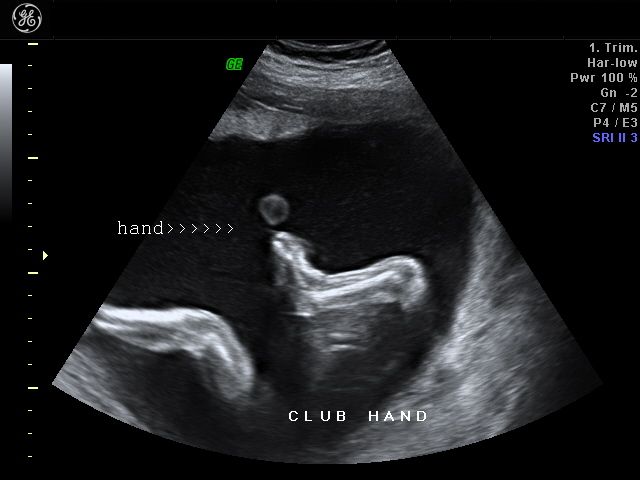
Fetal club hand deformity:


This 2nd trimester fetus shows short forearm bone (radius) with radial deviation of the wrist. The image 2 nd is a B-mode ultrasound image showing this deformity of the hand. The other 3 images are 3-D (3 dimensional) ultrasound images showing the same anomaly in this fetus. These ultrasound images suggest fetal radial club hand anomaly. Radial club hand is the commonest fetal club hand anomaly. It is important to look for other fetal malformations as this anomaly is usually not isolated. Ultrasound images courtesy of Dr. Dilraj Gandhi, India.

Intrauterine fetal death (IUFD):

These ultrasound images of the fetal skull reveal overlap of the bones of the calvarium following fetal demise. This is known as the Spalding sign and is diagnostic of intrauterine fetal death. Images courtesy Dr. Ravi Kadasne, UAE.


http://www.ultrasound-images.com/fetus-general.htm

Early pregnancy (1st trimester):

1
2
3


4

5


6


7


These ultrasound images show a normal early fetus of 9 weeks gestational age (1st trimester) and are taken via the transabdominal route. Among the structures seen are the fetus with the bulkier head (cephalic part) and the fetal heart on Color Doppler and Power Doppler imaging. Spectral Doppler waveform (image 1&2) shows the cardiac pulsations with heart rate. The fetal cardiac pulsations are also well visualized in the Power Doppler image of the fetus (image 3&4). The amniotic membrane (amnion) is also well visualized as it covers the fetus and is well clear of the gestational sac (image 1). At a later date, the amnion merges with the gestational sac and would not be visualized. The early umbilical cord is also visualized as it extends from the fetus to the uterine wall (ultrasound/ Doppler image on bottom row).

Upper Extremity Deep Venous Thrombosis (DVT)

Upper Extremity Deep Venous Thrombosis (DVT)

Upper-extremity DVT now accounts for about 8% of all cases of DVT. Subclavian vein (SCV) clot is usually associated with arm swelling. Jugular venous (JV) clot is often asymptomatic.


Diagram of venous drainage of upper extremity: A-Medial cubital vein; B-Basilic vein; C-Cephalic vein; D-Brachial vein; E-Axillary vein; F-Subclavian vein; G-External jugular vein; H-Internal jugular vein; I-Brachiocephalic vein; J-Superior vena cava.

Exam
1-Patient position: Arm is abducted about 45¡ to 90¡ from patient. The head is elevated a little, or put patient flat or even in Trendelenburg position to distend the veins.
2-Use a linear transducer (5 MHz for average patient, 3.5 MHz may be needed for obese patients, 7.5 MHz if thin). Use compression on the axillary, brachial, and jugular veins just as you would compress lower extremity veins. The SCV cannot be directly compressed and requires more careful examination. Generally the SCV is best evaluated from the infraclavicular approach. The central portion can be usually imaged from the supraclavicular approach.

Gray scale

First just look at the SCV. Note changes in size with respiration and sniff maneuver. A normal SCV should collapse at least 60%. With complete obstruction, there is no response to these respiratory maneuvers and the vein is often asymmetrically dilated. Look at the opposite presumed normal side.

Duplex Doppler

Compare bilateral waveforms. Look for absent or very decreased flow in the symptomatic side compared to the normal side. Asymmetry indicates a problem. Unlike the lower extremities there may be phasic flow in the SCV even with a completely occluding thrombus.

Color Doppler

Look for filling defects, which could suggest a thrombus. Slow flow can indicate a possible thrombus in the BCV or SCV especially if there is slow flow compared with the opposite side. Comparison will also help you with the settings if you are having trouble getting color on the abnormal side. Look from both infra- and supraclavicular approaches.


Figure A. Transverse image of internal jugular vein (red arrowheads) and carotid artery (red arrow). Figure B. Transverse image with transducer compression applied shows the compressibility of internal jugular vein (red arrowheads) while the carotid artery (red arrow) maintains its shape.

Sonographic Findings of DVT:
1) Lack of complete compressibility of vein.
2) Visualization of intraluminal thrombus with complete or partial obstruction of the vein lumen.


Longitudinal image of the subclavian shows enlargement and non-compressibility with the transducer (red arrowheads) and an intraluminal thrombus (red arrow).

3) Distention of the vein compared to the adjacent artery.


Deep Vein Thrombosis-Upper Extremity. Color Doppler image of the subclavian vein shows that the lumen is distended with hypoechoic thrombus (red arrows). Very minimal blood flow in the vein is evident. Flow is present in an adjacent artery (red arrowhead).
4) Abnormal venous Doppler signals, i.e. continuous nonphasic flow, reduced or absent flow with distal augmentation, or no obtainable signal.


Duplex Doppler demonstrating non-phasic flow in a peripheral vein with thrombosis.
Lower Extremity DVT
DVT is a common clinical problem with significant associated mortality from pulmonary embolism. There are approximately 2 million cases per year and nearly 60,000 related deaths per year. DVT can be a difficult disease to diagnose because the signs and symptoms are non-specific and unreliable. Some of the signs and symptoms include calf tenderness, unilateral limb swelling, tachycardia, and tachypnea.


Diagram of the venous drainage of the lower extremity: A-Plantar venous arch; B-Posterior tibial veins; C-Peroneal veins; D-Anterior tibial veins; E-Popliteal vein; F-Femoral vein; G-Deep femoral vein; H-Common femoral vein.

Exam
1-Have the patient âs upper body elevated 10¡-20¡ and examine the leg in external rotation. Do both legs in high risk patients. In low risk symptomatic patients, do the symptomatic leg only. If the Doppler flow is continuous or dampened, sample the contralateral CFV for comparison.
2-In the transverse plane, compress each centimeter of the CFV, SFV and popliteal vein down to the trifurcation. Also identify and compress the central portions of the deep femoral and greater saphenous where these vessels join the CFV. In cases where portions of the deep venous system are poorly visualized in grey scale, longitudinal color images with color filling the vessel can be used to exclude acute DVT. Obtain representative Doppler tracings from the CFV, SFV and popliteal veins. Spontaneous and phasic flow is normal. If the flow is not phasic, assess response to augmentation. If acute thrombus is identified, determine the extent with gentle compression.
3-Calf veins should be examined in patients with anatomic calf pain and a negative femoral-popliteal exam. Follow paired posterior tibilal vein from the medial malleolus proximal. Assess peroneal veins if possible. Greater and lesser saphenous, perforators, calf muscle veins and varicosities may be evaluated if symptomatic. The region of the leg that is tender should be imaged.

Sonographic Findings of DVT:

1) Lack of complete compressibility of vein (beware: a normal femoral vein in adductor canal region may not compress).

2) Visualization of intraluminal thrombus with complete or partial obstruction of the vein lumen.

3) Distention of the vein compared to the adjacent artery


Figure A. Acute thrombus (red arrows) in lower extremity vein is hypoechoic and is commonly indistinguishable from flowing blood. The vein is distended at the site of the acute thrombus (red arrows). Figure B. Inability to compress the vein at the junction of the thrombusis (red arrows) is prime evidence of thrombus.
4) Abnormal venous Doppler signals, i.e. continuous nonphasic flow, reduced or absent flow with distal augmentation, or no obtainable signal.

A

B
A. Longitudinal color Doppler demonstrating normal blood flow in a peripheral vein. B. Longitudinal color Doppler image with transducer compression applied shows flow in the femoral artery (red arrow) and very minimal flow in the femoral vein (red arrowhead). The femoral vein does not compress with transducer pressure, indicating intraluminal thrombus.
5) Continuous, nonphasic flow in CFV unilaterally, with phasic flow in contralateral CFV, suggesting iliac vein outflow obstruction, i.e. DVT of extrinsic compression.


A


B
A. Duplex Doppler demonstrating phasic flow in a normal peripheral vein. B. Duplex Doppler demonstrating non-phasic flow in a peripheral vein with thrombosis


http://www.med-ed.virginia.edu/courses/rad/edus/index18.html


Tuesday, July 13, 2010

Normal phasic changes in venous flow during respiration:


During respiration there are phasic changes seen in the venous flow of the lower limb veins. This is best studied using Triplex imaging, and especially by spectral pattern of venous flow. Upper left image shows changes in flow (in superficial femoral vein), with increase during inspiration, caused by lower intra-thoracic pressure and vise versa during expiration. The Doppler image on right side shows similar changes in the popliteal vein of the same limb. This suggest continuity of flow with transmission of pressure all the way upto the vena cava and the right atrium.

Normal compressibility of the lower limb veins:


The above 2 Doppler images show the normal superficial femoral vein (Left) and the Normal popliteal vein (Right). Compression of the veins by the Doppler probe causes the normal veins to collapse COMPLETELY (compressibility). Presence of thrombus would cause poor or absent compression of the vessels. Note that the arterial flow is not hampered by the probe pressure. However, the veins disappear in the right half of each image.

Flow augmentation:


On applying pressure to the lower limb, distal to the veins being assessed, there is increase in flow (spectral Doppler trace). Both the superficial femoral vein (image on Left) and popliteal vein (Right) show marked increase ( flow augmentation) on applying pressure below. This suggests absence of thrombosis in the intervening parts of both veins.

Cessation of flow on Valsalva maneuver:

Another technique to assess the patency and absence of thrombus in the part of the venous system above the point of examination is to use the Valsalva maneuver. During deep inspiration and holding of breath, there is normal abrupt cessation of flow in the vein. In image above, the superficial femoral vein shows total cessation of flow. This is therefore, normal.


http://www.ultrasound-images.com/vascular.htm

Internal Jugular Vein Phlebectasia:


The above ultrasound/ Doppler images show a typical ectasia of the Rt. IJV in a young child. The diameter of the Rt. internal jugular vein is seen to increase from 8mm. (at rest) to almost 23mm. (on Valsalva). Images are courtesy of Ravi Kadasne, MD, UAE.