Best Bath Store
All Natural Blend of 14 Herbs Gentle Cleanse- $20 Off Colonix Now! Use Promo Code 20J
Amberen - Breakthrough Menopause Treatment
728x90
Custom Search

Tuesday, July 13, 2010

Ectasia of Internal Jugular vein:


This was a young adult male with complaint of small swelling in the left side of neck and mild dysphagia. On Color Doppler examination of the vessels of the neck, the right side showed normal diameter and flow in the right internal jugular vein and common carotid artery (see image on top left). However the left jugular vein showed a fusiform dilatation of the lower part of the vessel (close to its origin, ie: the proximal portion). Here, the vessel measured almost 12 to 14 mm. in diameter at rest. On deep inspiration and Valsalva maneuver, the rise in intrathoracic pressure resulted in diameter of the Internal jugular vein measuring 15 to 17 mm. (see image at bottom left). Compared to the the IJV on the right side the left IJV (internal jugular vein) also showed marked turbulence of flow both on Color Doppler imaging (see images on bottom left) and spectral Doppler waveform. The ultrasound/ Color Doppler images/ findings suggest Ectasia of the left Internal Jugular vein.
Reference: http://www.jultrasoundmed.org/cgi/reprint/18/6/411.pdf (free article and images).

Carotid artery plaque:


This middle aged male patient had a recent partial stroke affecting the left side of face and left upper limb. The B-mode ultrasound images of the right Common carotid artery show an atheromatous plaque of the lower third of the vessel. This plaque is non calcific and shows no evidence of ulceration. The Color Doppler images of the common carotid artery show no significant obstruction to blood flow in this artery. Possibly, there might have been a small embolic episode some time ago resulting in cerebral ischemia on this side.

Ultrasound and Color Doppler imaging of vertebral artery:


The vertebral arteries course through the foramen of the transverse processes of the cervical vertebrae (from C-6 upwards). The vertebral artery is seen sonographically, between the transverse processes of the cervical vertebrae, as segments. The part within the transverse processes is hidden by the bone. The normal vertebral artery (see color Doppler images above) shows the same direction of flow (and hence the same color as the common carotid artery anterior to it).

Intima-media thickness (IMT) of carotid artery:


The carotid artery/ arteries consist of 3 layers- the intima (the inner most thin layer of endothelium), the middle layer or media (formed by smooth muscles) and the outermost layer- the adventitia (formed by loose connective tissue. On grey scale sonography, the long section ultrasound image produces 2 parallel lines - the inner most line is bright (echogenic), thin and corresponds to the intima; the media is the dark line just outer to the intima. The measurement of the total thickness (intima media thickness) or IMT helps assess the arterial wall for presence of plaques or thickening. Normal common carotid artery thickness should be less than 0.9 mm. In the ultrasound images above, the IMT measures 0.6 to 0.7 mm. (normal).

Another sign to identify the ECA (external carotid artery):

ECA- systole:
ECA- early diastole
ECA and ICA - systole- color flow present:


ECA- late diastole- fades out:


ECA- poor flow in early diastole


ECA- no flow during late diastole: absent color flow signal


A very useful sign to identify the normal ECA is looking for flicker or fading out of the Color Doppler flow in the ECA during diastole. This is due to the very low absent flow in the ECA during diastole, as opposed to the ICA and CCA, both of which show significant flow during diastole. As a result, the ECA flickers on during cardiac systole (see Color Doppler images of the ECA and ICA above) and fades out (absent flow) during diastole). 3 of the Color Doppler images above are axial sections through the ECA and ICA while the other 3 images show the ECA and ICA just emerging from the bifurcation of the CCA (common carotid artery). All images by Joe Antony, MD. Machine used here is the Toshiba Nemio-XG ultrasound system.

The temporal tap sign of the (ECA) External carotid artery:


An important method of differentiating the ECA from the ICA is the "temporal tap" sign. Tapping the temporal artery (a branch of the ECA) at the level of the zygomatic arch, just anterior to the external ear, produces fluctuations in the spectral waveforms of the ECA. This is seen in the above ultrasound images showing vertical dips and peaks during the diastolic flow. (Compare the Doppler images on left (without the tap) with the image on right (during temporal tap)).

Doppler waveform of normal ECA (External carotid artery):


The ECA (right ECA here) shows very high (compared to ICA) PSV values and hence a sharp systolic peak and rather poor flow during diastole (seen as low EDV or end diastolic velocity). The PSV (Vmax) in this case is = 105/cms./sec. The normal range of PSV (peak systolic velocity) for the ECA is from 77 cms./sec. to 115 cms./sec.


Spectral Doppler waveforms of the normal ICA (internal carotid artery):


The Doppler images above show the spectral waveform of the normal ICA (Internal carotid artery-Rt.). The systolic peak in the ICA is broader than the ECA or even the CCA. Also, note the high (and persistent) diastolic flow. The normal PSV (Vmax in our image), ranges from55 to 88 cms./sec. in the ICA. This is true for the post bulbar (part distal to the carotid bulb) part of the ICA. (In our case the PSV or Vmax = 68 cms./sec).

Spectral Doppler waveform of the normal Common carotid artery (CCA):


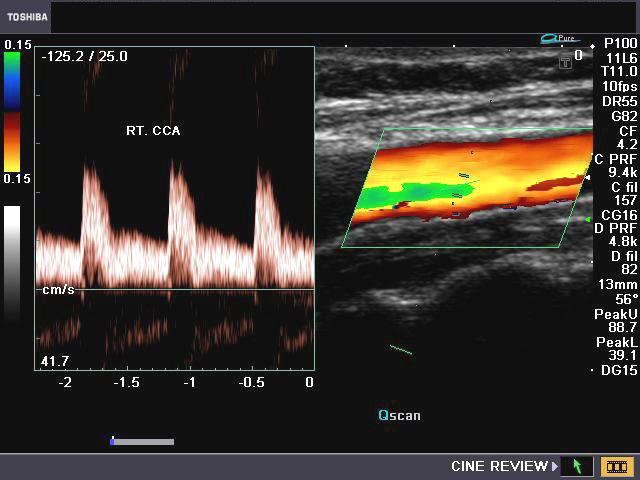
The above images (Rt. CCA) show moderately broad systolic peaks and moderate diastolic flow in diastole. The peak systolic velocity (PSV or V-max) is also in a range between that of the ICA and ECA. This is the typical appearance of the waveform of the CCA. Normal PSV for the CCA is usually less than 100cms./sec. (In this case, the PSV= 94 cms./sec.). The PSV in the CCA increases towards its proximal part (ie: towards the aorta).

The above color Doppler images show a cross section through the bifurcation of the (Rt.) common carotid artery into its two main branches: 1) Rt. ECA- the external carotid artery 2) Rt. ICA- the internal carotid artery. The image on right shows a section just above the bifurcation. IJV= the internal jugular vein (seen in blue color). Note that the ECA is more anterior and medial to the ICA. Also, the ICA (internal carotid artery) is larger than the other branch- the ECA.


The above Color Flow images show a long section through the Rt. CCA (common carotid artery) bifurcating into the ICA (internal carotid artery) and ECA (external carotid artery). Note the wider caliber of the ICA. (arrow points to the bifurcation).


These ultrasound images of a young, asymptomatic adult female patient reveal multiple calcific plaques of the common carotid arteries of both sides. The intimal plaques measure 1.5 to 4mm. in size. These sonographic images are diagnostic of dystrophic calcification of the intima of the carotid arteries. Such lesions are very unlikely to cause stroke or thromboembolic events and are hence of little significance. All ultrasound images taken with a Nemio - XG ultrasound system, by Joe Antony, MD, India.
References:1) http://www.evtodayarchive.com/03_archive/0902/et0902_15.html (a good article.. free).
The celiac artery arises from the anterior surface of the abdominal aorta and immediately divides into 3 branches: the common hepatic, the splenic and the left gastric arteries. The above ultrasound and Color Doppler images show the normal celiac artery with the 2 main branches, the splenic and common hepatic arteries. The left gastric is not visualized usually on sonography, being a small branch.


http://www.ultrasound-images.com/vascular.htm

pseudo aneurysm of popliteal artery

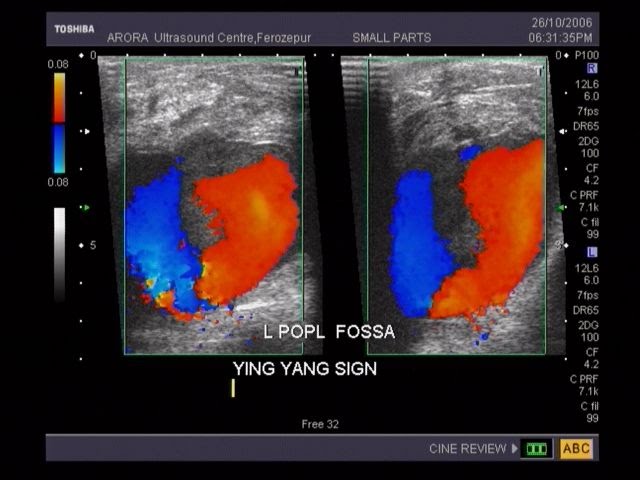
This patient was a drug addict with history of injecting into the popliteal vessels. He presented with a pulsatile swelling in the Lt. popliteal region. Color Doppler study shows the typical cystic structure, in close relation to the Lt. popliteal artery, with swirling blood flow within it. This produces what is typically called the yin -yang sign on color doppler. (The picture below shows the typical yin yang symbol).
Pseudoaneurysms are formed by trauma to the artery, usually iatrogenic, resulting in a perfused sac surrounding the vessel. It is lined either by the media or the adventitia or even by the soft tissue surrounding the injured vessel.
CT or MR imaging can help by locating the lesion and the feeding vessel (especially on 3D reconstruction).
Case and images courtesy of Dr. Vikas Arora, MD, Ferozepur, India.


References: 1) http://www.jultrasoundmed.org/cgi/content/full/25/9/1211#SEC1
2) http://findarticles.com/p/articles/mi_qa3794/is_200508/ai_n15846548


Absence of flow Lt. femoral vein (transverse section)
(longitudinal section) Lt. femoral vein
Absent flow left politeal vein


http://sites.google.com/site/drjoea/vascular
Thrombosed Lt. iliac vein


http://sites.google.com/site/drjoea/vascular

non-compressible Lt. femoral vein

Monday, July 12, 2010

The highest velocity obtained was approximately 350 cm/s (F).

The AT measures 0.11 sec. A color Doppler image of the stenotic left renal artery origin is seen in image .
The Doppler waveform obtained from the segmental renal arteries within the right kidney shows a tardus parvus shape with absence of the ESP .


http://www.gehealthcare.com/usen/ultrasound/education/products/cme_ren_art.html#7

post stenotic turbulance

Image shows a spectral waveform obtained in the area of poststenotic turbulence just beyond the maximal area of stenosis. The velocity is lower at 317 cm/s and the waveform profile is irregular due to the turbulent flow.


http://www.gehealthcare.com/usen/ultrasound/education/images/renart/fig16c.jpg

color bruit

A Doppler reading obtained near the renal artery origin shows velocities over 600 cm/s in systole and over 300 cm/s in diastole consistent with a high grade stenosis. Note that rolling the patient into a decubitus position and angling the probe back toward the aorta have purposefully decreased the angulation of the renal artery. The arrows are pointing to a bruit that is evident on the spectral display.


http://www.gehealthcare.com/usen/ultrasound/education/images/renart/fig16b.jpg

color bruit

Image A is a color Doppler image of a stenotic right renal artery origin. A color bruit is seen in the tissue surrounding the area of the post stenotic turbulence. The presence of the bruit can help to identify the location of the stenosis and increase diagnostic confidence.


http://www.gehealthcare.com/usen/ultrasound/education/products/cme_ren_art.html#7

Sunday, July 11, 2010

Transabdominal sonogram of an intrauterine pregnancy with marked oligohydramnios associated with intrauterine growth retardation. It is difficult to appreciate the fetal anatomy in the presence of oligohydramnios.
Normal spectral Doppler waveform of umbilical artery and vein in a near-term fetus.

Spectral Doppler waveform of umbilical artery in intrauterine growth retardation (IUGR) demonstrates loss of diastolic flow. Pulsatility of the umbilical vein can also be seen. Both of these findings suggest severe IUGR, and when seen, a perinatologist should be immediately informed.
Etiology
The causes of intrauterine growth retardation (intrauterine growth restriction; IUGR) can be either fetal or maternal
1-Fetal causes of IUGR include aneuploidy, trisomy 13, trisomy 18, triploidy, intrauterine infection, cytomegaloviral infection, and toxoplasmosis.
2-Maternal causes of IUGR include use of drugs (including recreational drugs such as marijuana), alcohol consumption, placental insufficiency, diabetes, late conception (possible cause), and a history of having a baby small for his or her age.
Asymmetrical vs symmetrical IUGR
In most cases of IUGR, especially those due to primary placental insufficiency, the fetal abdomen is small, but the head and extremities are normal or near normal. This finding is known as the head-sparing effect. In cases of severe, early-onset IUGR (those due to chromosomal anomalies), the fetus tends to be more symmetrically small. This condition leads to the existence of 2 distinct subgroups; however, these subgroups significantly overlap.
Sonographic criteria for IUGR
1-The sonographic criteria for IUGR include (1) an elevated ratio of femoral length to abdominal circumference (AC), (2) an elevated ratio of head circumference (HC) to AC, and (3) unexplained oligohydramnios.
2-The AC measurement is the best single measurement to assess fetal growth because, in growth curtailment, the liver is virtually always affected. Hadlock charts can be used to calculate the fetal weight from the AC.12 Most ultrasonography machines also use the Hadlock method of calculating fetal weight. The literature describes at least 47 formulas for the estimation of fetal weight. Using the Shepard formula (AC and biparietal diameter [BPD]), one can come within 5% of the true fetal weight and within 10% of the fetal weight 80% of the time. However, 20% of the time, the estimation of the fetal weight may be discrepant by more than 10%.
3-Oligohydramnios is an indicator of IUGR. Amniotic fluid of less than 5 cm, as measured in the four quadrants, is suggestive of oligohydramnios. Other causes of oligohydramnios include death in utero, renal agenesis, and premature rupture of membranes.
4-Abnormal findings on Doppler waveforms include the following:
-Highest uterine artery PI – lowest uterine artery PI greater than 1.1
- Persistence of protodiastolic notch, unilateral or bilateral, after 23 weeks is suggestive of IUGR or preeclampsia.
- RI greater than 0.55 with bilateral notches
- RI greater than 0.65 with a unilateral notch
-RI greater than 0.70 with or without notches
-RI greater than 90th percentile for a given gestational age regardless of notches
-An S/D ratio of greater than 3 after 30 weeks of gestation is abnormal.
-The reversal of flow in ductus venosus is suggestive of a fetus with severely compromised IUGR and reflects fetal metabolic acidemia.
5-Degree of Confidence
-Fetal weight below the 10th percentile has negative predictive value of 99%, a sensitivity of 89%, and a specificity of 88% for the detection of IUGR.
-An elevated HC-to-AC ratio has a negative predictive value of 98%, a sensitivity of 82%, and a specificity of 94% for the detection of IUGR.
-Decreased weight with decreased amniotic fluid and the presence of hypertension are good predictors of IUGR.