Best Bath Store
All Natural Blend of 14 Herbs Gentle Cleanse- $20 Off Colonix Now! Use Promo Code 20J
Amberen - Breakthrough Menopause Treatment
728x90
Custom Search

Wednesday, October 7, 2009

Lymphoma overview


Click on the image to enlarge


Lymphoma overveiw
Lymphoma is a type of cancer
involving cells of the immune system, called lymphocytes. Just as cancer represents many different diseases, lymphoma represents many different cancers of lymphocytes-about 35 different subtypes, in fact.
Lymphoma is a group of cancers that affect the cells that play a role in the immune system, and primarily represents cells involved in the lymphatic system
of the body.


The lymphatic system is part of the immune system. It consists of a network of vessels that carry a fluid called lymph, similar to the way that the network of blood vessels carry blood throughout the body. Lymph contains white blood cells called lymphocytes. Lymphocytes attack a variety of infectious agents as well as many cells in the precancerous
stages of development.
Lymph nodes are small collections of lymph tissue that occur throughout the body. The lymphatic system involves lymphatic channels that connect thousands of lymph nodes scattered throughout the body. Lymph flows through the lymph nodes, as well as through other lymphatic tissues including the spleen
, the tonsils, the bone marrow, and the thymus gland.
These lymph nodes filter the lymph, which may carry bacteria, viruses, or other microbes. The lymph nodes, or glands as they may be called, filter the lymph, which may on various occasions carry different microbial organisms. At infection sites, large numbers of these microbial organisms collect in the regional nodes and produce the swelling and tenderness typical of a localized infection. These enlarged and occasionally confluent collections of lymph nodes (so-called lymphadenopathy
) are often referred to as "swollen glands."
Lymphocytes recognize pathogens (infections and abnormal cells) and destroy them. There are 2 major subtypes of lymphocytes: B lymphocytes and T lymphocytes, also referred to as B cells and T cells.
B lymphocytes produce antibodies (proteins that circulate through the blood and lymph and attach to infectious organisms and abnormal cells). The combination attachment cell or antibody
microbial organism essentially alerts other cells of the immune system recognize and destroy these intruders, also known as pathogens.
T cells, when activated, can kill pathogens directly. T cells also play a part in the mechanisms of immune system control, to prevent the system from inappropriate overactivity or underactivity.
After fighting off an invader, some of the B and T lymphocytes "remember" the invader and are prepared to fight it off if it returns.
Cancer occurs when normal cells undergo a transformation whereby they grow and multiply uncontrollably. Lymphoma is a malignant
transformation of either lymphocytes B or T cells or their subtypes.
As the abnormal cells multiply, they may collect in 1 or more lymph nodes or in other lymph tissues such as the spleen.
As the cells continue to multiply, they form a mass often referred to as a tumor
.
Tumors often overwhelm surrounding tissues by invading their space, thereby depriving them of the necessary oxygen
and nutrients needed to survive and function normally.
Because of their uncontrolled growth, lymphomas can encroach on and/or invade neighboring tissues or distant organs.
In lymphoma, abnormal lymphocytes travel from one lymph node
to the next, and sometimes to remote organs, via the lymphatic system.
While lymphomas are often confined to lymph nodes and other lymphatic tissue
, they can spread to other types of tissue almost anywhere in the body. Lymphoma development outside of lymphatic tissue is called extranodal disease.
Lymphomas fall into 1 of 2 major categories. Hodgkin lymphoma (HL, previously called Hodgkin's disease) and all other lymphomas (non-Hodgkin lymphomas or NHLs).
These 2 types occur in the same places, may be associated with the same symptoms, and often have similar gross physical characteristics. However, they are readily distinguishable via microscopic
examination.
Hodgkin disease develops from a specific abnormal B lymphocyte lineage. NHL may derive from either abnormal B or T cells and are distinguished by unique genetic markers.
There are 5 subtypes of Hodgkin disease and about 30 subtypes of non-Hodgkin lymphoma.
Because there are so many different subtypes of lymphoma, the classification of lymphomas is complicated and includes both the microscopic appearance and well-defined genetic and molecular rearrangements.
Many of the NHL subtypes look similar, but they are functionally quite different and respond to different therapies with different probabilities of cure. HL subtypes are microscopically distinct, and typing is based upon the microscopic differences as well as extent of disease.
Lymphoma is the most common type of blood cancer in the United States. It is the sixth most common cancer in adults and the third most common in children. Non-Hodgkin lymphoma is far more common than Hodgkin disease.
In the United States, about 54,000 new cases of NHL and 7000 new cases of HL were diagnosed in 2004, and the overall incidence is increasing.
About 24,000 people die of NHL and 1400 of HL each year, with the survival rate of all but the most advanced cases of HL greater than that of other lymphomas.
Lymphoma can occur at any age, including childhood. Hodgkin disease is most common in 2 age groups: young adults aged 16-34 years and in older people aged 55 years and older. Non-Hodgkin lymphoma is more likely to occur in older people.
PET/CT FINDINGS
Marked FDG uptake throughout the mediastinum and in the right axilla/supraclavicular area corresponding to bulky adenopathy on the CT portion of the exam compatible with malignancy.

Please see the lower image .

TREATMENT / FOLLOW UP
Chemotherapy (CHOP). Follow-up PET/CT ordered following 1 cycle.
FOLLOW UP PET/CT FINDINGS
Complete resolution of abnormal FDG activity compatible with a good response to therapy. Focal apparent FDG activity in the left supraclavicular area was not present on the uncorrected images compatible with an attenuation correction artifact. Bulky adenopathy is still present, but no increased FDG activity is present. Please see the upper image .
DISCUSSION
This case demonstrates the power of PET/CT to assess response to therapy soon after initiation. The strength of the modality is in the ability to assess an early response to therapy by assessing the metabolic changes. As shown in the second set of images, there is still considerable soft tissue abnormality present, but no increased FDG activity. Evidence suggests that for non-Hodgkin’s lymphoma, patients are to be categorized as responders (better overall survival) only if there is minimal or no residual FDG activity on follow up exams after therapy initiation. The metabolic changes can be assessed after one cycle of chemotherapy, whereas the soft tissue component will take much longer to regress and may remain indefinitely.

Wegeners granulomatosis

Click on image to enlarge


Wegener's Granulomatosis


General Considerations
Hallmarks
Small to medium sized systemic vasculitis
Granulomatous inflammation
Necrosis
Unknown etiology
Incidence of 1 case per 30,000
Affects predominantly whites (91%)
M>F
Mean age at diagnosis = 45

Sites of Involvement:
Lung (>90%)
Renal (75%)
Rapidly progressing glomerulonephritis, chronic renal failure
Trachea (15-60%)
Subglottic Stenosis
Other
Paranasal sinuses, nose (saddle nose deformity)
Ears, eyes, oral cavity
Skin, joints, nervous system
Rarely
Heart, GI tract and brain
Can potentially involve any organ in the body
Diagnosis:
American College of Rheumatology Classification
(2 out of 4 criteria is 88% sensitive and 92% specific for the diagnosis)
Nasal or oral inflammation
Abnormal chest X-ray
Urinary sediment
Biopsy
Imaging Findings
Conventional Radiography
Pulmonary nodules
Most common finding (40-70%)
Typically multiple and bilateral with a tendency to cavitate (50%)
Cavitary lesions may lead to atelectasis or pneumothorax
Thick or thin walled, well or ill circumscribed
Tendency to wax and wane
Size varies (1.5-10cm)
Air space consolidation
Waxing and waning infiltrates
May be mistaken for pneumonia
Pulmonary hemorrhage or edema
Hilar lypmhadenopathy
Normal in 20%
CT
Useful in further defining extent of disease seen in plain film, and revealing lesions not seen on plain film including:
Interstitial abnormalities
Tracheobronchial Abnormalities
Findings suggestive of vasculitis
Differential Diagnosis
For cavitary lung lesions
Infarction
Septic pulmonary emboli
Carcinoma
Squamous cell carcinoma
Infection
TB, Fungal, Bacterial
Rheumatoid nodules
Prognosis and Treatment
Tracheostomy may be required for tracheal strictures
Independent Risk factors of mortality
Older age
Absence of ear, nose and throat involvement
Renal or Cardiac involvement


Langerhans histiocytosis

Click on image to enlarge

Langerhans Histiocytosis

Also known as eosinophilic granuloma(tosis)
Proliferative disorder of the Langerhans cells
Normally found in the skin (and a few other organs) and serve as antigen-presenting cells
Rare diseases, affecting neonates up to adults
2:1 male to female predominance
Prognosis
Mortality and morbidity are associated with the clinical presentation and age of onset of the disease
Worst prognosis for neonates presenting with the disseminated form
Three clinical forms
Acute disseminated Langerhans cell histiocytosis (aka Letterer-Siwe disease)
Occurs most frequently in infants 2 years of age or younger (and occasionally adults)
Presents with multi system organ involvement
Cutaneous lesions resembling seborrheic dermatitis involve the scalp, face, trunk and buttocks as the dominant clinical feature (nearly 80% of patient will have this)
Infiltration of bone marrow and other organs lead to concurrent hepatosplenomegaly, lypmhadenopathy, pulmonary lesions, anemia, thrombocytopenia, recurrent infections (otitis media)
Eventually, there are destructive osteolytic bone lesions
If untreated, this disease is rapidly fatal
With chemotherapy, 5 year survival rate is approximately 50 percent
Univocal Langerhans cell histiocytosis (aka Eosinophilic granuloma or granulomatosis)
Usually only affects the skeletal system of young adults
Typically presents as an osteolytic lesion involving the
Calvaria
Vertebra
Rib
Mandible
Femur
Ilium
Scapula
Bony lesions are usually asymptomatic
In some cases, can cause pain and even pathologic fractures
Pulmonary lesions may be the only presenting symptom and organ involved, especially in adults
Skeletal lesion is usually indolent in nature
Can heal spontaneously or be cured by local excision or irradiation
Pulmonary lesions are typically followed and treated with supportive care
Multifocal Langerhans cell histiocytosis (aka Hand-Schuller-Christian disease)
Triad
Diabetes insipidus
Exophtalmos
Holes in the bone, usually the head (calvarium)
Commonly affects children
Can lead to
Lypmhadenopathy
Hepatomegaly
Splenomegally
Diabetes insipidus is secondary to infiltration of the posterior pituitary stalk by the Langerhans cell
About a third of these patients will also display cutaneous lesions
Some will experience spontaneous regression while others can be treated with chemotherapy


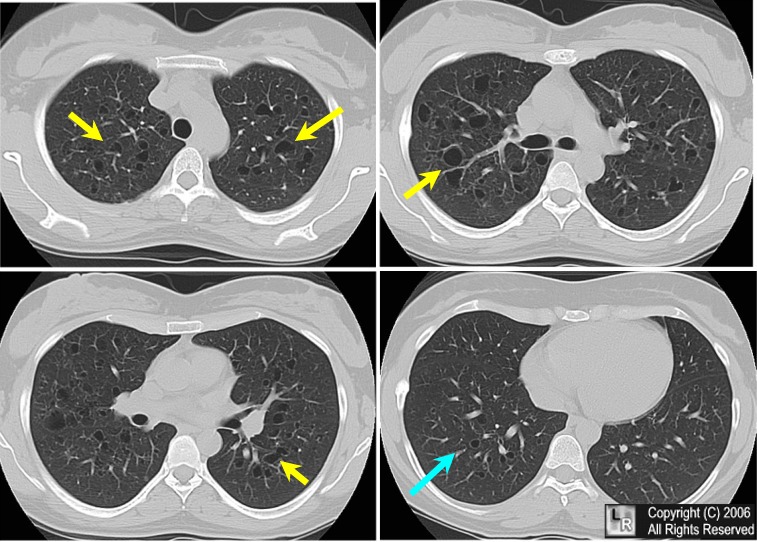
Langerhans histiocytosis (Eosinophilic granuloma of lung). Four selected non-enhanced axial CT scans of the chest show multiple small, irregularly-shaped, cysts of varying sizes with thin walls scattered throughout the lungs (yellow arrows) but predominantly seen in the upper lung fields while sparing the costophrenic angles and lung bases (blue arrow).

Quick Facts

Letterer-Siwe Disease
10% of histiocytosis X
Acute disseminated, fulminant form
Age at onset
Several weeks after birth to 2 years
Pathology
May be confused with leukemia
Symptoms
Hemorrhage, purpura
Severe anemia
Fever
Hepatosplenomegaly and lypmhadenopathy
Bone involvement in 50%
Widespread lytic lesions
Prognosis: 70% mortality rate
Hand-Schuller-Christian
15-40% of Histiocytosis X
Triad of:
Exophthalmos (33%)
Diabetes insipidus (30-50%)
Lytic skull lesions
Pathology
May simulate Ewing's sarcoma
Age at onset
5-10 years
Target organs
Bone
Lytic skull lesions with overlying soft tissue nodules
Large geographic skull lesions
"Floating teeth" with mandibular involvement
Soft tissue
Hepatosplenomegaly is rare
Lypmhadenopathy which may be massive
Lung
Cyst and bleb formation with spontaneous PTX
Ill-defined diffuse nodular disease often leading to fibrosis and honeycombing
Prognosis: spontaneous remissions and exacerbations
Eosinophilic granuloma
60-80% of Histiocytosis X
Usually confined to bone
Age at onset
5-10 years highest frequency
Male predominance 3:2
Location
Calvarium>mandible>spine>ribs>long bones
Most are monostotic (50-75%)
Target organs
Skull (50%)
Diploic space of parietal bone most often
Round or ovoid punched out lesions with beveled edge
Sclerotic margin during healing phase
Beveled edge=hole-within-a-hole
Button sequestrum- bony sequestrum within lytic lesion
Axial skeleton (25%)
"Vertebra plana"-"coin-on-edge"(Calve disease)=collapse of vertebral body, mostly thoracic
Most common cause of vertebra plana in children
Proximal long bones (15%)
Expansile, lytic lesions, mostly diaphyseal
Soft tissue mass
Laminated periosteal reaction
Lung (20%)
Age peak between 20-40 years
Multiple small nodules
Predilection for apices
Prototype for honeycomb lung
Recurrent pneumothoraces (25%)
Rib lesions with fractures common
Nuclear Medicine
Negative bone scans in 35%
Bone lesions usually not Ga-67 avid
Ga-67 may be helpful in detecting non-osseous lesions
Prognosis: excellent

Tuesday, October 6, 2009

Childhood sweets and adult violance


Childhood sweets link to adult violence May encourage impulsive behaviour
Children who eat sweets and chocolate every day are more likely to be violent as adults, new research has found.
Results from the research showed that 10-year olds who ate sweets and chocolate almost every day were significantly more likely to have been convicted for violence at age 34.
Previous research has shown that diet can be associated with behavioural problems, including aggression. However, UK scientists wanted to find out how childhood diet affected behaviour as an adult.
In the study, published in this month's British Journal of Psychiatry, scientists analysed data from almost 17,500 people born in 1970. They discovered that 69% of participants who were violent at the age of 34 had eaten sweets and chocolate nearly every day during childhood, compared to 42% who were non-violent.
This association between sweets and violence as an adult remained after adjusting for other factors such as where the child lived, educational qualifications and car ownership.
The researchers put forward several explanations for the link. Dr. Simon Moore from Cardiff University said: "Our favoured explanation is that giving children sweets and chocolate regularly may stop them learning how to wait to obtain something they want.
"Not being able to defer gratification may push them towards more impulsive behaviour, which is strongly associated with delinquency.
The researchers concluded: "Targeting resources at improving children's diet may improve health and reduce aggression."

Smoking in pregnancy


Smoking in pregnancy linked to child psychosis Risk highest in children of heavy smokers
Smoking has long been implicated as a cause of many diseases, including in the babies of mothers who smoke. A new study has now linked the emergence of psychotic symptoms in teenagers to smoking by their mothers during pregnancy.
Over 6,000 12-year olds were studied as part of the research. They were asked about the occurrence of psychotic symptoms such as hallucinations or delusions. Just over 11% had suspected or definite symptoms of psychosis.
Smoking during pregnancy was found to be associated with an increased risk of psychotic symptoms in the children. The researchers observed a 'dose-response effect', meaning that the risk of psychotic symptoms was highest in the children whose mothers smoked the most heavily during pregnancy.
Curiously, smoking cannabis during pregnancy seemed to have no link to psychosis, although the number of mothers reported this behaviour was small.
Drinking alcohol during pregnancy was linked to psychosis in children, but only in mothers who drank more than 21 units a week in early pregnancy.
The nature of the link between smoking in pregnancy and psychosis in children is not clear. It is estimated that between 15% and 20% of women in the UK continue to smoke during their pregnancy.
One of the leaders of the study, Dr Stanley Zammit, said: "If our results are non-biased and reflect a causal relationship, we can estimate that about 20% of adolescents in this cohort would not have developed psychotic symptoms if their mothers had not smoked. Therefore, maternal smoking may be an important risk factor in the development of psychotic experiences in the population."
The study was carried out by researchers at universities in Cardiff, Bristol, Nottingham and Warwick and was published in the October issue of the British Journal of Psychiatry.

Thinning of hair


Over the years, there have been many myths regarding thinning hair.
google_protectAndRun("ads_core.google_render_ad", google_handleError, google_render_ad);
However, scientists have now proven that “clogged” hair follicles and poor scalp circulation do not cause thinning hair. In addition, researchers have also found that wearing hats or helmets does not lead to hair loss.
Unfortunately, genetics account for more than 90% of all cases of men and women with thinning hair. Illness, stress, poor diet, and certain prescription medications can also aggravate hair loss. However, hair loss that can be attributed to one of these factors is generally much easier to treat than thinning hair that is solely the result of genetic influences. Speaking to a doctor or dermatologist may help you determine what is causing your thinning hair.The medical term for hair loss caused by thinning hair is alopecia. Some people who suffer from thinning hair begin to notice hair loss in their early teens, although most hair loss doesn’t occur until the 30s or 40s. Hair loss is more common among men, but typically causes greater stress for women who have been raised to believe their hair is an important part of their femininity.Hair loss caused by thinning hair cannot be cured, but several non-surgical treatment options are available. Rogaine brand hair treatment products, containing a minoxidil liquid solution, are available over-the-counter in versions formulated for both men and women. Men who suffer from thinning hair may have suitable results with the prescription medication finasteride, sold under the brand name Propecia. Corticosteroids injections, pills, or creams are sometimes prescribed for patients suffering from persistent hair loss that has not responded to other alternative treatments. These treatment methods require a commitment to continual use, however, since any improvement in thinning hair will be reversed after treatment is discontinued.
google_protectAndRun("ads_core.google_render_ad", google_handleError, google_render_ad);
While the type of hair care products you use can make it easier to style your hair, products can’t slow or stop the hair loss process. However, poor quality shampoos, conditioners, and styling aids may cause hair breakage that can sometimes be mistaken for hair loss. If you’re bothered by thinning hair, switching to salon quality hair care products might be a worthwhile investment.Hair transplants and scalp reduction surgery can be used to treat thinning hair. However, these treatments are expensive, painful, and carry serious risks. Most experts will only recommend surgery if other treatment methods have failed and you feel your thinning hair is having a substantial impact on your quality of life.

Your first prenatal test


Most women are excited for their first ultrasound. It offers a sneak peak of the unborn baby and might offer hints at its sex. Your doctor will let you know how often you need an ultrasound. Most women will have one or two ultrasounds during pregnancy. Here's what to expect for this prenatal test.
What is an ultrasound?
An ultrasound uses high-frequency sound waves to create a picture of your unborn baby. It also shows images of your uterus, amniotic sac, placenta and ovaries.
In this procedure, a small device called a transducer sends sound waves into the body. The waves reflect off internal structures, including your baby. Then the transducer receives the sound waves and sends a picture to a screen.
The images appear on the screen during the exam. Pictures can be printed or the whole procedure can be recorded on video. Your doctor can usually discuss results of an ultrasound with you soon after the exam is over.
Why is ultrasound used in pregnancy?
Ultrasound is used to:
Check on your baby's health status, including position, movement, breathing, growth and heart rate
Make sure the placenta is healthy and attached normally
See the number of fetuses
Calculate the expected due date
Detect some birth defects
See how much amniotic fluid is in the uterus
Ultrasound can also be used to diagnose a possible miscarriage or ectopic pregnancy, or to determine the cause of vaginal bleeding. Sometimes it can give you a hint as to the sex of the baby. This is not always accurate, though.
How do I prepare for an ultrasound?
You'll need to have a full bladder, which can be uncomfortable, especially during pregnancy. But a full bladder pushes the uterus up for better viewing. You may be asked to drink up to six glasses of water in the two hours before the exam. You can't urinate until the ultrasound is over. Wear clothes that make it easy to expose your abdomen. The exam usually takes 15 to 20 minutes.
What are the different types of ultrasounds?
There are two main types of ultrasounds: abdominal and vaginal.
Abdominal ultrasound. You'll lay on a table with your abdomen exposed. Then the ultrasound technician puts a gel on your abdomen. The gel improves how the transducer works on your skin. The transducer is gently placed on your abdomen and moved over your stomach and pelvis. There are two more detailed types of abdominal ultrasounds:
Doppler. Higher-intensity sound waves are used to study the movement of blood and listen to the baby's heartbeat.
Three- and four-dimensional (3-D and 4-D). The 3-D ultrasound takes thousands of images at once, making the image look more realistic. A 4-D ultrasound shows movement as well as still shots.
Vaginal ultrasound. The vaginal ultrasound can take a closer look at the organs and fetus. It is used more often in early pregnancy.
For this procedure, you will change into a hospital gown, lie down and put your feet into stirrups, like you are preparing for a pelvic exam. A protective sheath is placed over the transducer and then it's inserted into the vagina. The ultrasound procedure is painless. You may feel mild discomfort from the pressure of the transducer.
Is ultrasound safe?
There is no evidence that ultrasounds are harmful to mom or baby. They have been done for many years without problem. But the American College of Obstetricians and Gynecologists and the American Institute of Ultrasound in Medicine discourage the use of ultrasounds for nonmedical purposes. Using an ultrasound to detect the sex of the baby or to take a keepsake photograph should be done only if the ultrasound is needed for medical reasons - and only by certified medical personnel. Even though there are no known risks linked to ultrasounds now, it is possible that some will be found in the future. Radiation is not used for ultrasound.

Stay free in this summer


Stay safe this summer An introduction to our summer health guides
Summer is a great time of year with holidays, sunshine, long warm evenings and barbecues all adding to the fun.
So it would be a shame if our enthusiasm for outdoor pursuits at this time of the year affected our health. Sunburn, damage to our eyes and food poisoning are hazards that we can easily avoid if we follow some simple tips and guidelines.
So we have put together a set of handy guides for the main danger areas you will encounter in the sun this summer.
Why not print them out and pack them in your suitcase before heading off on holiday? And even if you are having a so-called "staycation" don't be fooled by the summer rain we always seem to get. In between the clouds the sun shines brightly and just as dangerously as it does in the med so make sure you select the right suncreams and keep your skin covered.
Just follow these guides to be safe in the sun.

Keep slim and help save the planet


Keep slim and help save the planet, say scientists Rising BMIs across the world contribute to climate change
Maintaining a healthy body weight is good news for the environment, according to a study which appears today in the International Journal of Epidemiology.
Because food production is a major contributor to global warming, a lean population such as that in Vietnam, will consume almost 20% less food and produce fewer greenhouse gases compared with a population in which 40% of people are obese (close to that seen in the US today).
Transport-related emissions will also be lower because it takes less energy to transport slim people. The researchers based at the London School of Hygiene and Tropical Medicine, estimate that a lean population of 1 billion people would emit 1.0 GT (1,000 million tonnes) less carbon dioxide equivalents per year compared with a fat one.
In nearly every country in the world, average body mass index (BMI) is rising. Between 1994 and 2004 the average male BMI in England increased from 26 to 27.3, with the average female BMI rising from 25.8 to 26.9 (about 3 kg - or half a stone - heavier). Humankind - be it Australian, Argentinean, Belgian or Canadian - is getting steadily fatter.
'When it comes to food consumption, moving about in a heavy body is like driving around in a gas guzzler', say scientists Professor Ian Roberts and Dr. Phil Edwards who led the study.
'The heavier our bodies become, the harder and more unpleasant it is to move about in them, and the more dependent we become on our cars.
Staying slim is good for health and for the environment. We need to be doing a lot more to reverse the global trend towards fatness, and recognise it as a key factor in the battle to reduce emissions and slow climate change', they conclude.

Football is better for Women


Football better than running for women Better physical and social benefits
Football is better than running for improving women's overall fitness, according to new research.
What's more, scientists from the University of Copenhagen also found that women are less likely to drop playing football from their busy lives compared with running.
In a two year study, due to be published in the Scandinavian Journal of Medicine and Science in Sports, researchers compared the physical, psychological and social benefits of women's football compared with running.
One hundred women were separated into three groups - football, running and a control group. Both the footballers and runners trained twice a week for an hour.
After 16 weeks, the researchers found that the women footballers showed a "marked improvement in maximal oxygen uptake, muscle mass and physical performance.
Although women usually prefer cardiovascular training, some type of strength training is needed to maintain bone and muscle strength for later in life, the scientists said.
"While playing soccer, the women have high heart rates and perform many sprints, turns, kicks and tackles, making soccer an effective integration of both cardio and strength training," said Professor Peter Krustrup, who led the study.
The social aspects of football - meeting other women and taking part in a team sport, also meant that women were more likely to continue with football than running. And women found it easier to fit in football - which requires a fixed place and time - into their busy lives rather than running.
“In the recent decade, we have seen a significant rise in women and girls playing soccer. It seems as though women are really beginning to take in soccer and make it a popular sport for women on their own terms.
"This is a very positive step forward, not only because of the improved physical fitness and health profile but also for the enjoyment of sports”, Mr Krustrup concluded.

Fruit and Health

Smoothies count towards your 5 daily fruit and veg Claims upheld by Advertising Standards Authority
It's not always easy to reach the daily recommended intake of 5 portions of fruit and veg every day.
So the idea of drinking a handily packaged fruit smoothie as part of our daily routine is an attractive one. This was the claim made by the Innocent smoothie brand in a TV advert which was challenged by some complaining viewers.
But now in a ruling by the Advertising Standards Authority (ASA) - the official advertising watchdog - this claim has been upheld.
Innocent claimed that "each one of our cartons contains all this fruit, which means each glassful contains two whole portions. Two of your five a day".
This was made possible because the Department of Health had recently changed it's guidelines to allow smoothies containing all edible parts of a fruit, or 100% fruit juice, to count as two portions of fruit.
The ASA said: ''We understood that each 250ml serving contained all the edible parts of the pulped fruit, contained a sufficient amount of edible fruit and of fruit juice, and, additionally, did not include a dairy product. Because of that, we understood that a 250ml portion from Innocent's current smoothie range could provide two portions of a person's five a day.''
You can read the Department of Health's guidelines
here.
In order for a smoothie to qualify, it must be purely made from fruit. Some smoothies contain other ingredients, such as dairy products or sugar. These would therefore not qualify.

Bacterial Vaginosis

Exercise and Children


UK children not exercising enough Happier texting or logging on
Only one in eight UK children get the recommended 60 minutes exercise a day, according to a survey released today by the British Heart Foundation (BHF).
The survey also found that:
1 in 3 children exercise for less than an hour a week
78% of children did not know the recommended daily amount of exercise
30% admitted they "can't be bothered" to exercise
1 in 5 children considered exercise to be a "chore"
Over half of the children surveyed claimed to spend more than a hour each day texting or chatting on websites such as Facebook and MySpace.
This is despite the fact that recent research has predicted if current trends continue, two thirds of all children will be overweight or obese by 2050.
Former Olympic sprinting champion Sally Gunnell expressed her concern about the results: "As a mum, I know how children can benefit from being active. It's something that all children should enjoy as part of a healthy lifestyle and is also a great way to socialise with friends."
Dr Mike Knapton, BHF Director of Prevention and Care, said: "We have a generation of kids growing up who have a shockingly blasé attitude towards exercise and being active."
To counter this trend, the BHF is launching an "Ultimate Dodgeball" fund-raising event for young people to encourage them to become active.
Dr Knapton explained: "Ultimate Dodgeball is a great way to get children interested in sport and physical activity - young people need to switch off their square eyes and get in the habit of exercising now."
The BHF is also relaunching its Yoobot web site which is designed to help young people make better choices about the food they eat.
The survey is part of the BHF's Food4Thought campaign.
More information

Anti-Atkins diet extends life

"Anti-Atkins" diet extends life... ...in flies. It's a start!
The high protein Atkins diet was a fad among weight obsessed celebrities some years ago. Now a new study suggests that a low protein diet may be able to extend life - at least in flies.
Although a reduced protein diet leads to an overall reduction in the body's processing of proteins for energy, the study found a surprising increase in one particular mechanism in the body's cells responsible for the generation of energy from nutrients.
Even more surprisingly, when the scientists turned this process off by genetic manipulation, the low protein diet had no effect on lifespan, and when they enhanced its effectiveness they were able to extend the lifespan of flies even when fed a high protein diet.
Study leader Pankaj Kapahi said: "In flies, we see that the long-lived diet is a low protein diet and what we have found here is a mechanism for how that may be working."
The results, which appear in the October edition of the journal Cell, also provide a new level of understanding of the regulation of mitochondrial genes and suggests new areas of research into the interplay between mitochondrial function, diet and energy metabolism.
Mitochondria act as the "powerhouse" of the cells. It's well known that mitochondrial function declines with age in many animal species, and in humans with Type II diabetes and obesity. "Our study shows that dietary restriction can enhance mitochondrial function hence offsetting the age-related decline in its performance," said Dr Kapahi.
These results follow on from other studies that have suggested that reducing your calories can lead to longer and healthier life spans for a number of different animals. So far these findings have not been confirmed in humans.

Self Male Breast Examination

SMV Thrombosis


Find more videos like this on radRounds Radiology Network

Breast Calcification Workup

BREAST CALCIFICATION WORK UP:
-When you look to a mammography film containing calcification, the first sign to be observed is if this calcification diffuse or regional.
-If it is diffuse, and whether this calcification is covering the whole breast or seen as multiple similar clusters, both appearances are considered to be benign calcification with BI RADS category 2.
-If it is regional, the second sign to be evaluated is whether this calcification with no ductal distribution or with ductal distribution.
-If there is no ductal distribution , look to the size of this calcification.
-If the size of calcification is more than 0.5mm looks to the shape of this calcification.
-If it is rounded, coarse and with smooth borders, it is considered to be ROUND CALCIFICATION which is of benign nature with BI RADS categories 2.
-If it is with irregular shape and size, it is considered to be coarse, heterogeneous calcification which is of suspicious nature with BI RADS category 4.
-I f the size is less than 0.5mm, look to the shape whether it is round or flakes and small in size with hazy appearance or thin linear or curvilinear with discontinuity.
-If it is the former, this called amorphous calcification, which could be bilateral and diffuse with category 2, or bilateral and clusters with category 3, or unilateral with clusters, or new lesion in follow up, or with contra lateral cancer, the latter three should be considered BI RADS category 4(suspicious).
-If it is less than 0.5 with variable size and shape could be pleomorphic calcification which is more cancerous than amorphous one,if it is in linear distribution,it is considered to be category 5,and if it is in a segmental distribution considered to be in category 4.Usually amorphous and pleomorphic could be seen together.
-If it is linear or curvi linear with discontinuity, this should be considered as calcification with high probability of malignancies with BI RADS category 5.
-Also, if the size is less than 0.5mm with the volume of breast tissue affected more than 2cc this will be considered benign calcification with BI RADS category 2.
- Also, if the size is less than 0.5mm with cluster of calcification contain at least 5 points of calcification in a small volume of breast tissue less than 1cc, this will be considered suspicious with category 4.
-Finally, if the calcification showed ductal distribution in the form of segmental, ducts or branches of ducts or segmental or lobar, this should be considered suspicious with category 4.If it is with ductal calcification with linear pattern this should be considered as high probability of malignancies with category 5.
CONCLUSION:
-Look to the calcification, and then answer the following questions
-Is it diffuse or regional?
-If it is diffuse, considered it benign entity with BI RADS category 2
-If it is regional, look to the configuration of calcification, whether it is of ductal or no ductal distribution.
-If it is of no ductal distribution, look to the size of the lesion, if it is more than or less than 0.5mm.
-If it is more than 0.5mm, it will be either round calcification with category 2 or coarse and heterogeneous calcification with category 4, this depend on the shape of these calcification.
-If it is less than 0.5mm, it will be either amorphous calcification with different categories according to their distributions, or thin linear or curvilinear calcification which is categorized as 5.
-If it is of ductal distribution, it could be either of curvilinear shape(category 5) or other shape rather than curvilinear with segmental distribution, lobar distribution which could be categorized as 4(suspicious).

Midgut Volvulus


Find more videos like this on radRounds Radiology Network

How Mammography was performed

Radiology Round

Health and Salt

People unaware of hidden salt in their diet Bread, meat and cereals worst offenders
Over three quarters of people don't know that bread and cereals are among the top salt-containing foods in their diet, according to a new study.
In a survey of 2,267 people carried out by the Food Standards Agency (FSA), 73% of people questioned thought crisps and snacks contributed most salt to their diet, followed by ready meals (65%) and meat products (36%).
Only 13% of people mentioned bread and 12% thought cereals were among the top ten salt-containing foods in their diet. Most people thought foods which tasted the saltiest were the worst offenders rather than the every-day foods which we eat most often.
The survey also revealed that many people (40%) thought that supermarket value ranges contributed the most salt to their diets. However, in these budget conscious times, the good news is that this is not always the case. Some "big brand” foods actually contain more salt than their supermarket equivalent.
The FSA strongly advises everyone to check the labels. On average, people in the UK are eating 8.6g of salt a day - most from everyday foods such as bread and cereals. We should all be aiming to cut down to 6g of salt a day, preferably less!
Rosemary Hignett, Head of Nutrition at the FSA, said: "We are not suggesting people stop eating or even cut down on bread and breakfast cereals, because they are an important part of a healthy diet. But we are saying take a look at the labels to find one that is lower in salt.
"This could be a supermarket own-label product, and maybe one from the "value" range. If so, any cost saving is an added bonus."
Past research has shown that high salt levels in a person's diet put them at increased risk of high blood pressure, heart disease and stroke.

Fight Head Lice

Prostate

Self Breast Examination

Monday, October 5, 2009

Fungal Sinusitis

Click on the image to enlarge
1-Click on the image to enlarge.
2-Then,localise the lesion you see(where is it).
3-It is a completely opacified left maxillary sinus and mucosal thickening of the right maxillary sinus.
4-Then ,characterise these lesions
When we look to the density of left sinus component and that of right sinus mucoca you can easly suggest that these densities are hyper dense if compared to surrounding soft tissue.
As a rule hyperdense opacified sinus is a benign sign which could be due the following
-Inspissated secretions.
-Fungal or
-Blood
After contrast injection no enhancement noted denoting no masses.
According to the history of the patient we can know the exact cause of this appearance.
In such a case bilaterality of the lesions with right mucosal thickening can exclude blood in case of absence of history of trauma.On the other hand,absence of history of immuno suppresive disease could exclude fungal infection and so on.

Temporal bone infection

Click on image to enlarge 1-Click on the image to enlarge.
2- First,localise the lesion (where is it).
3-The lesion is in the region of the right temporal bone.
4-Then,characterise this lesion as follow
-In T1 MRI,it appears hypo intense.
-In T2 MRI,it appears hyper intense.
-In T1 MRI with contrast,it showed contrast enhancement.
-In Diffusion MRI,it showed no changes.
5-Impression:
A lesion in this region with contrast enhancement and no changes of its signal
on diffusion sequence should be infection and not a cholesteatoma.

Cholesteatoma


1-Click on the image to enlarge
2-Patient with relapsing cholesteatoma.
3-First localise the lesion(where is it)
4-The answer of this question =it is located at the site of operation on the left side.
5-Secondly,characterise this lesion as follow
In T1 MRI sequence,the lesion is hypo intense.
In T2 MRI sequence,the lesion is hyper intense
In T1 sequence with contrast injection, no enhancement seen
In Diffusion sequence,the lesion is hyper intense.
6-Impression:
A lesion in this location with no enhancement and showed hyper intensity on diffusion
sequence should be a cholesteatoma.

Breast Calcification


Breast Calcifications
Amorphous or Indistinct Calcifications:
These are often round or 'flake' shaped calcifications that are sufficiently small or hazy in appearance that a more specific morphologic classification cannot be determined.
Coarse, Heterogeneous Calcifications:
Irregular calcifications with varying sizes and shapes that are usually larger than 0.5 mm in diameter.
Fine, Pleomorphic or Branching Calcifications:
Fine pleomorphic calcifications are more conspicuous than the am orphic forms.They vary in sizes and shapes and are usually smaller than 0, 5 mm. Fine branching calcifications are thin, linear or curvilinear, may be discontinuous and smaller than o, 5 mm. Their appearance suggests filling in of the lumen of a duct involved irregularly by breast cancer.
Benign Calcifications:
Benign calcifications are usually larger than calcifications associated with malignancy. They are usually coarser, often round with smooth margins and are much more easily seen.
When you describe an abnormality (mass, architectural distortion, focal asymmetry or calcifications) always use the standard BI-RADS descriptors and mention the lesion size and location.

Peritoneal Pathology

PERITONEAL PATHOLOGY
1-Aortic aneurysm
-True aneurysm
-Pseudo aneurysm
-Inflammatory aneurysm
-Dissecting aneurysm
-Ruptured aortic aneurysm
2-Venous thrombosis
3- Lymph nodes
-Abdominal lymphoma
4-Abdominal wall
-Abdominal wall hernia
-Abdominal wall hematoma


A) Pulmonary lesions:
Focal:
-Nodules.
-Masses.
-Patches.
-Cavities
.
Diffuse:
-Reticular.
-Ground glass pattern.
-Nodular pattern.
-Cystic pattern.


Focal lesions:
-Nodules(Less than 3 cm).
Look to numbers, density, margin and calcification.
D.D. includes the following: Bronchogenic carcinoma, metastases, tuberculoma, Hamartoma, AVM and fungus.
-Masses (more than 3 cm).
Can be classified into solid and cystic, the solids include carcinoma and metastases while cystic include hydatid cyst.
-Patches (with air bronchograms).
Include Pneumonia, infarction, broncho-alveolar carcinoma and pulmonary contusion (history of trauma or rib fracture).
-Cavities
Look to the contents if there is
1-Fluid level, look to the surface of the fluid level, if it is straight suggests abscess, and if it is wavy it suggest ruptured hydatid cyst.
2-Only air, we look to the wall thickness, if it is thick this suggest chronic abscess, if it is thin ,here look to the site, if it is central in the lung, this should be pneumonia but if it is located peripherally and sub pleural this should be emphysematous bullae.
3- Intra cavitary soft tissue density, the most common lesion causing that appearance is the fungal ball, or then rupture hydatid cyst, break down in a tumor or blood clot(rare).

-Diffuse lesions:
1- Reticular pattern
:( interlacing linear shadows appearing as a mesh or net)
-Usual interstitial pneumonia. AND U
-Acute interstitial pneumonia.
-Non specific interstitial pneumonia.
-Desquamative interstitial pneumonia.
-Idiopathic interstitial fibrosis.
-Interstitial pulmonary edema.
-Collagen vascular diseases.
-Drug indused lung diseases
-Radiation indused lung diseases
2-Ground glass pattern
(increased attenuation of the lung with preserved of broncho vascular markings)
-Pneumonia.
-Acute pulmonary edema
-Pulmonary hemorrhage.
-AIDS +ground glass opacities=P.CARINII PNEUMONIA.
-Lung transplant+groung glass opacities=CMV or rejection
-Solitary ground glass opacities could be either broncho alveolar edema or carcinoma.


3-Nodular pattern
(multiple rounded opacities 1-10mm)
-Random distribution as TB, fungal and deposits.
-Special distribution
@Zonal as in pneumoconiosis.
@Peri lymphatics as in Sarcoid
@Broncho-vascular as in lymphoma and leukemia.
-Cavitating nodules
@Deposits
@Wegener’s granulomatosis.
@Septic emboli
@Rheumatoid lung
4- Cystic pattern (
multiple thin walled air containing lesions)
1cm or more in diameter
-Histiocytosis.
-Lymphangiolieomyomatosis.
-Lymphocytic interstitial pneumonia.
-Pneumocystis carinii pneumonia
-Centri lobular emphysema

MRI DIfferentiation between cholesteatoma and Ear inflammation

-Cholesteatoma chch. By
-Diffusion image: hyper signal
-T1 Contrast image:
No enhancement.
Presence of diffusion hyper signal and absence of contrast uptake favor Cholesteatoma.


-Inflammation chch.by
-Diffusion: No signal changes.
-T1 c.s.: Contrast enhancement(granulation tissue).
Presence of contrast enhancement and no signal changes in diffusion image favor inflammation.
Both are hyper intense inT2,hypo in T1.

Sunday, October 4, 2009

Cystic abdominal Lesions

Peritoneal cavity
1-Cystic Abdominal Masses
-Abscess
-Lobulated ascites
-Pancreatic pseudo-cyst
-Ovarian cyst/cystic tumor
-Lymphocyle
-Cystic Lymphangioma
-Enteric duplication cyst
Cystic Teratoma
2-Pseudomyxoma
3-Omental cake
4-Subphrenic abscess
5-Abdominal abscess


Cystic Abdominal Masses

Cystic Abdominal Masses
-Abscess
-Lobulated ascites
-Pancreatic pseudo-cyst
-Ovarian cyst/cystic tumor
-Lymphocyle
-Cystic Lymphangioma
-Enteric duplication cyst
Cystic Teratoma

Intracranial Calcification

INTRA-CRANIAL CALCIFICATION
A-Physiological Calcification
B-Pathological Calcification
1-Diagnostic
-Bilateral symmetrical basal ganglia calcification
@-Idiopathic
@-Familial
@-Hypo-parathyroidism
@-Pseudo-hypo-parathyroidism
@-Pseudo-pseudo-hypo-parathyroidism
@Hyper-para-thyroidism
@Fahr disease (Ferro calcinosis)
@-Encephalitis
@-Radiation therapy
@-Parkinsonism
@-Carbon mono-oxide intoxication
-Spotty non symmetrical periventricular foci of calcification.
C-T- C-T
$-Cytomegallo virus inclusion bodies
$-Toxoplasmosis
$-Cysticercosis
$-Tuberus sclerosis
-Gyral calcification
#-Sturge weber syndrome

2-Non diagnostic

Non Enhanced Intracranial Cysts

NON ENHANCED INTRA-CRANIAL CYSTS
A-Extra-axial
-Arachnoid cyst
No calcification&contain water&proton density-àhypo intense
-Epidermoid cyst
+ Or – calcification&proton density-àbright
-Dermoid
Mid line&fat content&marginal calcification
B-Intra-axial
-Hydatid cyst
No edema, calcification, mass effect or enhancement
-Cystic astrocytoma
-Porencephaly
Focal cavity filled with CSF&communicating with ventricle
C-Anterior part of the third ventricle
-Colloid cyst

Pattern of Brain Tumors Enhancement

PATTERN OF BRAIN TUMORS ENHANCEMENT
1-Homogenous Enhancement
-Meningioma.
-Lymphoma.
-Aneurysm.
2-Heterogenous enhancement
-Gliomas
-Metastases
.
3-Marginal enhancement
-Uniform--àn abscess
-Non uniform--àn astrocytoma
4-Serpigenous enhancement
-AVM
5-No enhancement
-Cysts
-Calcifications

Hydrocephalus


HYDROCEPHALUS
1-Definition:
Enlarged ventricular system due increased Intraventricular pressure.
2-MRI signs:
-Transependymal CSF permeation.
-Upward bowing and thinning of the corpus callosum
-Dilatation of ventricles.
3-Hydrocephalic types
-Obstructive: Obstruction proximal to foramina of Luschka and Magendie(lower image).
-Communicating: Obstruction is distal to fourth ventricle foramina(upper image).
-Normal pressure hydrocephalus
*Is a subset of communicating hydrocephalus?
*Hyper flow of CSF.
*Occurs in elderly.
*Ventricles dilated out of proportional to the enlarged cortical sulci.
*Key finding on MRI is marked loss of signal in aqueduct and adjacent third and fourth ventricles. In addition to the extent of this flow void starting from foramen of Monroe down to the fourth ventricle.
4-Causes of obstructive hydrocephalus
A) At the level of aqueduct of sylvious
*Tectal tumors
*Pineal region tumors
*Aqueductal Stenosis.
B)At the level of foramen of Monrow
*Colloid cyst
*Giant cell astrocytoma
5-Compensation process:
Occurs when a tumor close e.g. foramen of Monroe causing CSF permeation, than after that the lateral ventricles start to dilate resulting in decreasing Intraventricular pressure and interstitial edema start to resorb, this is called compensation process.
Presence of interstitial edema indicates presence of increased Intraventricular pressure and resorption of this fluid indicates normalized pressure even if ventricles still dilated.
Presence of interstitial edema=elevated ventricular pressure

D.D.of Brain Tumors


BRAIN TUMORS:
1-Gliomas:
-Low grade astrocytoma (grade 1 and 2) ---àbenign
-Anaplastic astrocytoma (grade3) ---àmalignant
-Glioblastoma multiforme (grade 4)-àmalignant
-Ependymoma, sub-ependymomas and oligodendrogliomas also considered as gliomas
-Pilocytic astrocytoma considered to be the most benign lesion while glioblastoma multiform is the most malignant form.
2-Primitive neuroectodermal tumor (PNET)
-In children
-Include medulloblastomas, pineoblastomas and ependymoblastomas
3-Hemangioblastoma
-Affect cerebellum and spinal cord.
-Form a part of von Hippel lindau disease
4-Metastases
-Single or multiple
-Leptomeningeal carcinomatosis
Brain tumors spread through CSF spaces
*Astrocytoma
*Ependymoma
*Pineoblastomas
*Medulloblastomas
Meningial enhancement
Benign
Meningial fibrosis and meningitis
Malignant
Leptomeningeal carcinomatosis

5-Tumors mimics
-Abscess
-Tumefactive multiple sclerosis
6-Meningioma
7-Sellar tumors
-Pituitary macro adenoma
-Pituitary micro adenoma
-Meningioma
-Craniopharyngeomas
-Hypothalamic gliomas and Dermoid
8-Cerebello-pontine angle tumors
-Acoustic neuroma and acoustic neuritis.
-Meningioma, Leptomeningeal scarring , lipoma, Epidermoid cyst.

D.D.of peri-ventricular lesions


1-PERI-VENTRICULAR LESIONS:
A) Smooth:
1-Transependymal CSF Permeation
B) Patchy:
1-Age:
-Young
Multiple sclerosis.
Vasculitis
Migraine.
ADEM (acute disseminated encephalomylomyelitis).
-Older
Deep White matter ischemia.
2-Aids:
-HIV encephalitis.
-Toxoplasmosis.
-Lymphoma.
-Progressive multifocal encephalopathy
3-Trauma:
-Shering injury.
4-Others:
-Lyme disease (similar appearance of multiple sclerosis).

BI-RADS categories

- BI-RADS 0 =Need Additional Imaging Evaluation and/or Prior Mammograms For Comparison:
- BI-RADS 1
=Negative: There is nothing to comment on. The breasts are symmetric and no masses, architectural distortion or suspicious calcifications are present.
- BI-RADS 2
=Benign Finding:Like BI-RADS 1, this is a normal assessment, but here, the interpreter chooses to describe a benign finding in the mammography report.
1- Involuting calcified fibro adenomas.
2- Multiple secretory calcifications.
3- Vascular calcifications.
4-fat-containing lesions such as oil cysts, lipoma, galactoceles and mixed-density Hamartoma all have characteristically benign appearances, and may be labeled with confidence.
5- Intramammary lymph nodes.
6- Implants.
7- Architectural distortion clearly related to prior surgery.
Radiologist is still concluding that there is no mammographic evidence of malignancy.

-BI-RADS 3
= Probably Benign Finding - Initial Short-Interval Follow-Up Suggested:A finding placed in this category should have less than a 2% risk of malignancy.It is not expected to change over the follow-up interval, but the radiologist would prefer to establish its stability.Lesions appropriately placed in this category include:
· 1-Non palpable, circumscribed mass on a baseline mammogram (unless it can be shown to be a cyst, an intramammary lymph node, or another benign finding),
· 2-Focal asymmetry which becomes less dense on spot compression view
· 3-Cluster of punctuate calcifications
· BI-RADS 4
= Suspicious Abnormality - Biopsy Should Be Considered:BI-RADS 4 is reserved for findings that do not have the classic appearance of malignancy but have a wide range of probability of malignancy (2 - 95%). By subdividing Category 4 into 4A, 4B and 4C , it is encouraged that relevant probabilities for malignancy be indicated within this category so the patient and her physician can make an informed decision on the ultimate course of action.
BI-RADS 5
= Highly Suggestive of Malignancy. Appropriate Action Should Be Taken: BI-RADS 5 must be reserved for findings that are classic breast cancers, with a >95% likelihood of malignancy. 1-A speculated, irregular high-density mass
2-a segmental or linear arrangement of fine linear calcifications
3- An irregular speculated mass with associated pleomorphic calcifications.
BI-RADS 5 contain lesions for which one-stage surgical treatment could be considered without preliminary biopsy. However, current oncologic management may require percutaneous tissue sampling as, for example, when sentinel node imaging is included in surgical treatment or when neoadjuvant chemotherapy is administered.
- BI-RADS 6
= Known Biopsy Proven Malignancy. Appropriate Action Should Be Taken BI-RADS 6 is reserved for lesions identified on the imaging study with biopsy proof of malignancy prior to definitive therapy.This category was added to the classification because sometimes patients are treated with neo-adjuvant chemotherapy. During the course of the treatment the tumor may be less visible, while still you know you are dealing with cancer.

Mammography interpretation

- BI-RADS 0 Need Additional Imaging Evaluation and/or Prior Mammograms For Comparison:
- BI-RADS 1 Negative: There is nothing to comment on. The breasts are symmetric and no masses, architectural distortion or suspicious calcifications are present.
- BI-RADS 2 Benign Finding:Like BI-RADS 1, this is a normal assessment, but here, the interpreter chooses to describe a benign finding in the mammography report.
1- Involuting calcified fibro adenomas.
2- Multiple secretory calcifications.
3- Vascular calcifications.
4-fat-containing lesions such as oil cysts, lipoma, galactoceles and mixed-density Hamartoma all have characteristically benign appearances, and may be labeled with confidence.
5- Intramammary lymph nodes.
6- Implants.
7- Architectural distortion clearly related to prior surgery.
Radiologist is still concluding that there is no mammographic evidence of malignancy.

-BI-RADS 3 Probably Benign Finding - Initial Short-Interval Follow-Up Suggested:A finding placed in this category should have less than a 2% risk of malignancy.It is not expected to change over the follow-up interval, but the radiologist would prefer to establish its stability.Lesions appropriately placed in this category include:
· 1-Non palpable, circumscribed mass on a baseline mammogram (unless it can be shown to be a cyst, an intramammary lymph node, or another benign finding),
· 2-Focal asymmetry which becomes less dense on spot compression view
· 3-Cluster of punctuate calcifications
BI-RADS 5Highly Suggestive of Malignancy. Appropriate Action Should Be Taken: BI-RADS 5 must be reserved for findings that are classic breast cancers, with a >95% likelihood of malignancy. 1-A speculated, irregular high-density mass
2-a segmental or linear arrangement of fine linear calcifications
3- An irregular speculated mass with associated pleomorphic calcifications.
BI-RADS 5 contain lesions for which one-stage surgical treatment could be considered without preliminary biopsy. However, current oncologic management may require percutaneous tissue sampling as, for example, when sentinel node imaging is included in surgical treatment or when neoadjuvant chemotherapy is administered.
- BI-RADS 6Known Biopsy Proven Malignancy. Appropriate Action Should Be Taken BI-RADS 6 is reserved for lesions identified on the imaging study with biopsy proof of malignancy prior to definitive therapy.This category was added to the classification because sometimes patients are treated with neo-adjuvant chemotherapy. During the course of the treatment the tumor may be less visible, while still you know you are dealing with cancer.

Value of unenhanced CT in an opacified sinus

click image to enlarge Value of unenhanced CT in an opacified sinus
1- The real value of unenhanced CT is the following: if you see an opacified sinus with hyper dense contents, it is usually a sign of benign disease. Tumor is not hyper-dense. The hyper density is due to one or a combination of the following:
· inspissated secretions
· fungus
· blood

The CT shows hyper density and the MRI shows hyper intensity on T2WI, both of which you will remember are benign signs in sino-nasal disease, indicating a Proteinaceous substance.

2- In general bright signal on T2 is a sign of benign disease, since fluid and mucosal disease usually have high water content. Secretions do not have solid enhancement. If you have an enhancing mass, you must rule out tumor.
3- MRI can discern secretions and mucosa from masses. When you understand the signal characteristics, you are readily able to distinguish soft tissues masses from inspissated secretions. The signal intensity of secretions can vary and mainly depends on the ratio of water to protein and the viscosity. Different protein contents result in different signal intensities on T1 and T2W-images (figure).

The signal intensity of sinus secretions depends on the protein content
4- When it comes to imaging of neoplasms of the paranasal sinuses, CT and MRI play complementary roles. It is not about the histology but about answering the question 'is it tumor or not?' and then determining the extent of the disease, for example intracranial or orbital extension. Use MRI to differentiate inspissated secretions from neoplasms.


Radiological differentiation between chronic otitis media and cholesteatoma

Click image to enlarge
Radiological differentiation between chronic otitis media and cholesteatoma
For the ENT-surgeon the differentiation between chronic otitis media (lower image) and cholesteatoma (upper image) is important. Both diseases often occur in poorly pneumatized mastoids.An important finding which can help differentiate the two conditions is bony erosion. Erosion of the lateral wall of the epitympanum and of the ossicular chain is common in cholesteatoma (around 75%). Erosion can occur in chronic otitis, but reportedly in less than 10% of patients. Displacement of the ossicular chain can be seen in cholesteatoma, not in chronic otitis. Cholesteatoma can present with a non-dependent mass while chronic otitis shows thickened mucosal lining. However, in both diseases the middle ear cavity can be completely opacified, obscuring a cholesteatoma.

External Auditary Canal Atresia

Click image to enlarge


External auditary canal atresia
In external ear atresia the external auditory canal is not developed and sound cannot reach the tympanic membrane. A conductive hearing loss is the result.It is important to note whether the atretic plate is composed of soft tissue or bone. The extent of ossicular chain malformation can vary from a fusion of the mallear head and incudal body to a small clump of malformed ossicles, which is often fused to the wall of the tympanic cavity. The mastoid portion of the facial nerve canal can be located more anteriorly than normal and this is important to report to the ENT surgeon in order to avoid iatrogenic injury to the nerve during surgery.
On the right a 2-year old boy with left bony external auditory canal atresia. The malleus and incus is fused . The cochlea is normal.